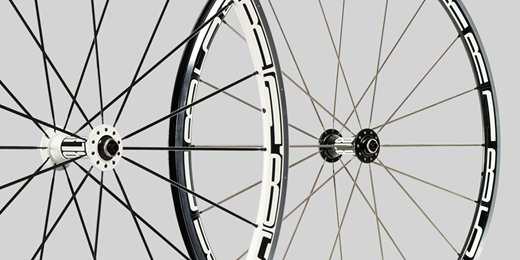
Quick definitions: A J-bend spoke has a small hook bent near one end that catches on the inside of the hub flange. A straight-pull spoke has no bend, it seats directly into a flange hole shaped to hold it without hooking, spreading load differently at that connection point.
What actually differs
Why the bend is actually the weak point
A J-bend spoke's hook has to be sharply bent near the head, and that bend is where metal fatigue concentrates over thousands of load cycles. It's rarely the reason an individual spoke breaks on a well-built wheel, but it's a known, documented weak point in the design, which is exactly the interface straight-pull spokes are engineered to remove.
What you give up in exchange
The trade-off is serviceability. A J-bend spoke that breaks on tour can often be replaced with whatever length the nearest shop has in stock. A straight-pull spoke usually needs to match the wheel's exact specification, which means carrying a spare or ordering from the wheel manufacturer if one breaks somewhere the exact part isn't stocked.
Straight-pull fits you ifyou're buying a higher-end current-generation wheel where it comes standard, and you're not planning multi-week remote touring where a generic spare spoke matters.
J-bend still makes sense ifyou want maximum field-repairability anywhere in the world, or you're buying a traditional alloy or budget wheelset where J-bend is simply the standard.