Not racing a crit? Everything below is written for a specific race format, not general riding. If you're not planning to line up at a crit, you don't need any of this to make a good wheel choice: see
how to choose a wheelset for a general framework, or
wheels for touring vs racing if you're comparing use cases.
What a crit actually demands: repeated hard accelerations out of corners, sustained pack speed on the straights between them, and predictable handling at low speed in a tight group. None of that matches the priorities of a long solo road race or a flat individual time trial, which is why "best road wheels" lists aren't written with crit racing in mind.
Rim depth: the acceleration-versus-speed tradeoff
"Rim depth" just means how tall the wheel's rim is, measured in millimeters from the spoke bed to the outer edge. A shallow rim looks almost flat from the side, a deep rim looks like a solid disc. Deeper rims hold speed better once you're up to it, because more of the rim's surface is doing aerodynamic work cutting through the air. But a deeper, heavier rim also takes more effort to spin back up to speed every time you slow down for a corner (riders call this "rotational weight" or "rotational inertia," and the plain version is: weight sitting at the rim's outer edge is harder to accelerate than the same weight closer to the hub). A crit has a lot of corners, so that re-acceleration cost happens constantly. Current wheel guidance for criterium and road racing generally settles on 45-55mm as the working sweet spot: enough rim depth to hold speed between corners, without the weight of a full deep-section wheel fighting you on every re-accel.
The archive's own SRAM S80 review (an 80mm deep-section wheelset) makes this concrete: one tester who raced the S80 on a crit course reported that with the "frequent corners of the crit circuit, he felt he was constantly shoving the wheels to get moving again," and the review's own recommendation for that rider was to shop for something lighter. That's a direct, named, historical example of the exact tradeoff described above, not a theoretical one.
Stiffness matters more in a pack sprint than on a solo ride
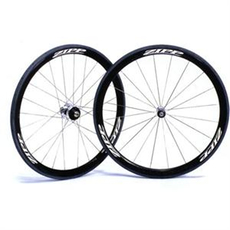
"Stiffness" here means how little the wheel flexes sideways when you stand up and put hard, uneven power into the pedals. A flexy wheel wastes some of that power bending instead of moving you forward. A crit finishes with a field sprint more often than not, and the surges leading into it happen in a tight group where a flexy wheel costs you a bike length you can't get back. The archive's Zipp 404 review describes the wheel as feeling "very stiff with no detectable flex" during a sprint, attributing it to the wide rim profile and a stiffened hub axle, and separately notes the 404 has carried riders "from the time trial stage, to the criterium, and on to the road race" as a single do-it-all wheel. Current guidance points the same direction: stiffer rims and hubs improve power transfer during sprint surges, which is exactly the repeated demand a crit places on a wheel.
Rim and tire width: cornering stability at speed
Crits are won and lost in corners as much as on the finish line. A wider rim gives the tire a wider, flatter contact patch with the road, which in plain terms means more rubber gripping the pavement when you lean the bike into a fast corner, so the tire is less likely to slip out from under you. The archive's Zipp 303 Firecrest review credits its wider-than-average rim with exactly this, giving the tire "a deeper bed, making these wheels amazingly stable around corners, even at speed." Current wheel specs generally land in the same place: roughly 21-23mm internal rim width paired with 25-30mm tires, which widens that contact patch further and gives more predictable grip through a fast corner exit than a narrow, old-style rim and tire combination.
Budget context: none of this requires spending race-wheel money if you're not actually racing. The archive prices below are for dedicated race wheels from a specialist brand; a rider doing club rides or their first century doesn't need a 45-55mm carbon race wheel to have a good time on the bike. See
budget vs premium wheelsets for what you actually get at each price tier.
A mid-depth, stiff wheelset fits you ifyou race or plan to race short, corner-dense circuits with a field that surges out of every turn, and you want one wheelset that also holds up reasonably well for club road races.
Skip the deep-section wheel ifyour target race has more than a couple of corners per lap. Save the 60mm+ wheel for a flat time trial or a pancake road race where it never has to re-accelerate out of a turn.
Archive-sourced, 2010-2014The Zipp 404, described in its archive review as suited to criterium, time trial, and road race use in one wheelset, sold for roughly $2,300 for the pair (tubular). The lighter, wider Zipp 303 Firecrest, singled out in its own archive review for crit-friendly cornering stability, sold for roughly $2,600. Both prices are historical archive figures, not current retail.