ComparisonNo affiliate links

Radial vs Crossed Spoke Lacing

Spoke lacing pattern is one of those details that sounds like a minor manufacturing choice but actually determines how a wheel handles braking, acceleration, and cornering force. The two main patterns, radial and crossed, aren't really competitors, they're tools for different jobs, which is why the same wheel often uses one pattern up front and the other in the rear.

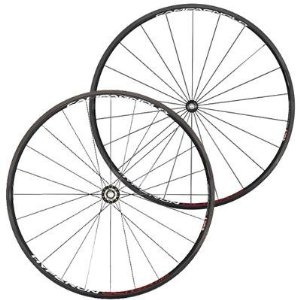
Campagnolo carbon wheelset showing mixed spoke lacing pattern, archived manufacturer product photo

A Campagnolo Ultra Two-series wheel; the Bora Ultra Two in the same family runs radial front and a G3 crossed pattern rear, per the archive review (archived manufacturer photo).

Quick definitions: Radial lacing runs each spoke in a straight line from hub flange to rim, the shortest possible path. Crossed lacing (2-cross, 3-cross, or a proprietary variant like Campagnolo's G3) angles each spoke so it crosses one or more neighboring spokes before reaching the rim.

What actually differs

FactorRadialCrossed
Torque transferWeaker, not recommended for a wheel that also drives the bikeBetter, spreads acceleration and braking force across the crossing pattern
Weight and aeroSlightly lighter and more aerodynamic, straight line of least resistanceSlightly heavier, more air resistance from the angled spokes
Typical placement on a road wheelFront wheel, which doesn't transmit drive torqueRear drive-side, which does
Archived exampleBora Ultra Two: 18 radial spokes frontBora Ultra Two: 21 spokes in a G3 crossed pattern rear; Easton EA70 uses radial front with a different crossed rear setup
Disc brake considerationCan be used on a disc front wheel, though some builders prefer light crossing there tooRecommended on any disc-brake wheel side that also handles braking torque

Why the front wheel gets away with radial

A front wheel on a rim-brake bike only has to resist braking force, not the twisting force of pedaling, so a radial lace pattern's straight, direct spoke line works fine there and saves a small amount of weight and aero drag. A disc-brake front wheel does see braking torque at the hub, which is part of why some current-generation disc wheels use a light crossing pattern even up front.

Why the rear drive side almost never goes radial

The archive's own examples make this consistent: Campagnolo's Bora Ultra Two runs a G3 crossed pattern specifically on the rear, and other wheels in the same archive follow the same logic. A radially-laced spoke has no leverage against the twisting force of hard pedaling, which over time can lead to spoke fatigue and even hub flange cracking on wheels that ignore this rule.

Radial makes senseon a rim-brake front wheel where weight and aero benefit slightly outweigh the small strength trade-off, which is why it's common there even on otherwise conservative wheel builds.
Crossed lacing is the right callon any drive-side rear wheel, and increasingly on disc-brake front wheels too, anywhere the spokes need to resist a twisting force rather than just a straight pull.
Frequently asked questions

Is a radial-laced rear wheel ever safe?
Most wheel builders and manufacturers avoid pure radial lacing on a drive-side rear wheel because it has no mechanical leverage against pedaling torque, which can accelerate spoke fatigue and, in rare cases, damage the hub flange over time. It's a widely followed rule in wheel building, not a stylistic preference.
What does Campagnolo's G3 pattern actually do differently from standard 2-cross or 3-cross?
G3 groups spokes in sets of three around the rim rather than spacing them evenly, a proprietary approach Campagnolo uses to fine-tune stiffness and weight distribution slightly differently than a traditional evenly-spaced crossed pattern, while still following the same core crossing principle.